The experiments reported here test children with small and larger numbers and measure two kinds of knowledge: how well number words map onto an imprecise sense of amount and how well children understand successor relations in the count list. The results show that mappings to approximate magnitudes help for small numbers but fail to explain comparisons of larger number words. Instead, children who know successor relations are the ones who grasp that later words indicate greater quantities.
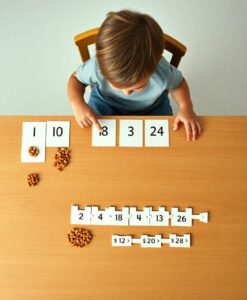
Thinking about number learning this way changes how we support early numeracy. If successor knowledge drives the later-greater insight, activities that strengthen the count sequence and attention to the order of words may matter more than exercises that pair number words with approximate piles. Follow the link to read the study and consider how these findings could shift classroom routines and inclusive approaches to helping all children build intuitive number sense.
Abstract
As we count up, number words that occur later in our count denote greater quantities. Here, we tested whether children’s understanding of this “later-greater” principle originates from associating number words with approximate magnitudes, or if instead it arises from knowledge of successor relations between individual number words. In Experiment 1 (N = 60), we found that children can identify the greater of two small number words (e.g., “six” vs. “ten”) based on associative mappings between number words and the ANS but do not rely on such mappings to compare larger numbers (e.g., “twenty-four” vs. “twenty-six”). In Experiment 2 (N = 60), we replicate these findings and show that children’s knowledge of successor relations between number words predicts later-greater knowledge, while mappings to the ANS do not. We conclude that children’s knowledge of successor relations, but not associative mappings to approximate magnitudes, are implicated in learning the later-greater principle.