
Those simple pictures are called minimal self-representations. They mark a boundary between the system and the rest of the world, connect directly to perception and action, and are resistant to errors like mistaking someone else for oneself. By showing that animals and young children can form allocentric accounts of when they acted, where their bodies are, or what they did cognitively, the paper suggests there is a spectrum of self-representation. Different species and developmental stages may therefore possess different kinds of self-knowledge without requiring the full-blown narrative self we often associate with mature human adults.
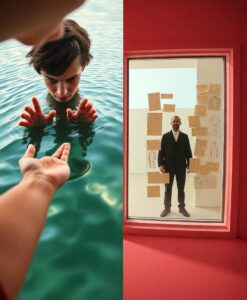
For readers interested in human potential, this approach reframes questions about inclusion and growth. If selfhood comes in kinds and can be built from simpler, linked representations, then fostering awareness and agency might look like nurturing specific representational skills rather than teaching a single model of “self.” Follow the full article to see how these ideas connect to learning, rehabilitation, and designing environments that support diverse ways of being aware of oneself.
Abstract
One question we can ask when investigating the nature of self-representation concerns the types of property that must figure in its content. Here, authors have claimed that self-representations must be about spatial, temporal, bodily, or mental properties. However, we can also ask a second question: how do we need to represent a property to self-represent it? I address this latter question. I argue that a distinction between egocentric and allocentric forms of representation—known from spatial cognition—also applies to representations of other kinds of property. I use examples drawn from animal cognition and developmental psychology to show how creatures allocentrically represent their temporal, bodily, and cognitive properties. These representations are minimal self-representations: they represent one’s properties so that an explicit differentiation is made between the system and other objects (or between the system’s actual and merely possible properties), they are directly linked to behavior and sensation, and they are immune to error through misidentification. The upshot is a view on which different creatures may self-represent more or fewer kinds of property. More substantive forms of self-representation (for instance, as exemplified by neurotypical adult human beings) then require integrated minimal self-representations of the right kinds of property.