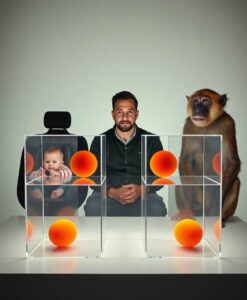
The authors brought the same question to three groups: six-month-old infants, adult humans, and Guinea baboons. Each group faced tasks designed to reveal whether reversing a launching event creates the sense that the roles of doer and undergoer have swapped. Across methods and species, the team did not find the specific pattern that would indicate spontaneous agent–patient attribution in these displays. Those null results invite a careful look at how we infer abstract event roles from minimal perceptual cues.
This topic matters because discovering whether event-role concepts are perceptual or learned shapes how we think about language development, animal cognition, and inclusive theories of human potential. If simple motion cues fail to trigger role attribution, where and when do these concepts emerge? The article opens up that question and points toward fresh experiments that could reveal how experience, social interaction, and species differences shape the beginnings of meaning.
Abstract
Languages describe “who is doing what to whom” by distinguishing the event roles of agent (doer) and patient (undergoer), but it is debated whether they result from nonlinguistic representations that may already exist in preverbal infants and nonhuman animals. The phenomenon of causal perception, where the subsequent movements of two objects A and B evoke the impression of A launching B, is a simple depiction of an agent−patient relation. The seminal study by Leslie and Keeble from 1987 proposed that infants of 6 months old may be able to attribute agent and patient roles to such causal displays, after they demonstrated the infants’ dishabituation upon seeing a launching event that was reversed. They introduced the idea that a role reversal had taken place upon reversing the direction of the launching event (launcher becoming launchee), but not in a noncausal temporal gap event where the agent and patient roles were not present. The present study tested this hypothesis in three different populations: 6-month-old human infants, human adults, and Guinea baboons (Papio papio). For the human infants, we applied a habituation-dishabituation design, and for the human adults and baboons, a conditional match-to-sample task. We were unable to replicate the findings of Leslie and Keeble in human infants. Similarly, we did not find evidence for an effect specific to reversing launching events in human adults and baboons. Inconsistent results across different studies call into question the role reversal paradigm for Michottean launches to study event role attribution.