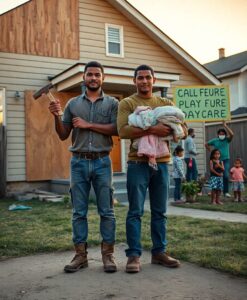

What matters for human potential is who gets to take part in the rebuilding. Training residents like Lonny and Teyon to be builders and peer supporters creates jobs, restores dignity, and passes skills across generations. Those kinds of projects reshape opportunity where federal programs fall short and they draw on traditions of mutual aid that strengthen resilience. I’ve learned that recovery work paired with housing, childcare, and ceremony increases the chance that people stay connected to family and culture while they heal.
If you want to understand how addiction recovery can be woven into community life rather than treated as an isolated problem, this reporting offers concrete examples and hope amid hard realities. Click through to see how a small tribal town is translating local knowledge into new services, and how those changes might influence conversations about funding, sovereignty, and inclusive growth elsewhere.
LODGE GRASS, Mont. — Brothers Lonny and Teyon Fritzler walked amid the tall grass and cottonwood trees surrounding their boarded-up childhood home near the Little Bighorn River and daydreamed about ways to rebuild.
The rolling prairie outside the single-story clapboard home is where Lonny learned from their grandfather how to break horses. It’s where Teyon learned from their grandmother how to harvest buffalo berries. It’s also where they watched their father get addicted to meth.
Teyon, now 34, began using the drug at 15 with their dad. Lonny, 41, started after college, which he said was partly due to the stress of caring for their grandfather with dementia. Their own addictions to meth persisted for years, outlasting the lives of both their father and grandfather.
It took leaving their home in Lodge Grass, a town of about 500 people on the Crow Indian Reservation, to recover. Here, methamphetamine use is widespread.
The brothers stayed with an aunt in Oklahoma as they learned to live without meth. Their family property has sat empty for years — the horse corral’s beams are broken and its roof caved in, the garage tilts, and the house needs extensive repairs. Such crumbling structures are common in this Native American community, hammered by the effects of meth addiction. Lonny said some homes in disrepair would cost too much to fix. It’s typical for multiple generations to crowd under one roof, sometimes for cultural reasons but also due to the area’s housing shortage.
“We have broken-down houses, a burnt one over here, a lot of houses that are not livable,” Lonny said as he described the few neighboring homes.
In Lodge Grass, an estimated 60% of the residents age 14 and older struggle with drug or alcohol addictions, according to a local survey contracted by the Mountain Shadow Association, a local, Native-led nonprofit. For many in the community, the buildings in disrepair are symbols of that struggle. But signs of renewal are emerging. In recent years, the town has torn down more than two dozen abandoned buildings. Now, for the first time in decades, new businesses are going up and have become new symbols — those of the town’s effort to recover from the effects of meth.
One of those new buildings, a day care center, arrived in October 2024. A parade of people followed the small, wooden building through town as it was delivered on the back of a truck. It replaced a formerly abandoned home that had tested positive for traces of meth.
“People were crying,” said Megkian Doyle, who heads the Mountain Shadow Association, which opened the center. “It was the first time that you could see new and tangible things that pulled into town.”
The nonprofit is also behind the town’s latest construction project: a place where families together can heal from addiction. The plan is to build an entire campus in town that provides mental health resources, housing for kids whose parents need treatment elsewhere, and housing for families working to live without drugs and alcohol.
Though the project is years away from completion, locals often stop by to watch the progress.
“There is a ground-level swell of hope that’s starting to come up around your ankles,” Doyle said.
Two of the builders on that project are Lonny and Teyon Fritzler. They see the work as a chance to help rebuild their community within the Apsáalooke Nation, also known as the Crow Tribe.
“When I got into construction work, I actually thought God was punishing me,” Lonny said. “But now, coming back, building these walls, I’m like, ‘Wow. This is ours now.’”
Meth ‘Never Left’
Meth use is a long-standing public health epidemic throughout the U.S. and a growing contributor to the nation’s overdose crisis. The drug had been devastating in Indian Country, a term that encompasses tribal jurisdictions and certain areas with Native American populations.
Native Americans face the highest rates of meth addiction in the U.S. compared with any other demographic group.
“Meth has never left our communities,” said A.C. Locklear, CEO of the National Indian Health Board, a nonprofit that works to improve health in Indian Country.
Many reservations are in rural areas, which have higher rates of meth use compared with cities. As a group, Native Americans face high rates of poverty, chronic disease, and mental illness — all are risk factors for addiction. These conditions are rooted in more than a century of systemic discrimination, a byproduct of colonization. Meanwhile, the Indian Health Service, which provides health care to Native Americans, has been chronically underfunded. Cutbacks under the Trump administration have shrunk health programs nationwide.
LeeAnn Bruised Head, a recently retired public health adviser with the U.S. Public Health Service Commissioned Corps, said that despite the challenges, tribal nations have developed strong survival skills drawing from their traditions. For example, Crow people have held onto their nation’s language; neighbors are often family, or considered such; and many tribal members rely on their clans to mentor children, who eventually become mentors themselves for the next generation.
“The strength here, the support here,” said Bruised Head, who is part of the Crow Tribe. “You can’t get that anywhere else.”
Signs of Rebuilding
On a fall day, Quincy Dabney greeted people arriving for lunch at the Lodge Grass drop-in center. The center recently opened in a former church as a place where people can come for help to stay sober or for a free meal. Dabney volunteers at the center. He’s also the town’s mayor.
Dabney helped organize community cleanup days starting in 2017, during which people picked up trash in yards and alongside roads. The focus eventually shifted to tearing down empty, condemned houses, which Dabney said had become spots to sell, distribute, and use meth, often during the day as children played nearby.
“There was nothing stopping it here,” Dabney said.
The problem hasn’t disappeared, though. In 2024, officials broke up a multistate trafficking operation based on the Crow reservation that distributed drugs to other Montana reservations. It was one example of how drug traffickers have targeted tribal nations as sales and distribution hubs.
A few blocks from where Dabney spoke stood the remains of a stone building where someone had spray-painted “Stop Meth” on its roofless walls. Still, there are signs of change, he said.
Dabney pointed across the street to a field where a trailer had sat empty for years before the town removed it. The town was halfway through tearing down another home in disrepair on the next block. Another house on the same street was being cleaned up for an incoming renter: a new mental health worker at the drop-in center.
Just down the road, work was underway on the new campus for addiction recovery, called Kaala’s Village. Kaala means “grandmother” in Crow.
The site’s first building going up is a therapeutic foster home. Plans include housing to gradually reunite families, a community garden, and a place to hold ceremonies. Doyle said the goal is that, eventually, residents can help build their own small homes, working with experienced builders trained to provide mental health support.
She said one of the most important aspects of this work “is that we finish it.”
Tribal citizens and organizations have said the political chaos of Trump’s first year back in office shows the problem with relying on federal programs. It underscores the need for more grassroots efforts, like what’s unfolding in Lodge Grass. But a reliable system to fund those efforts still doesn’t exist. Last year’s federal grant and program cuts also fueled competition for philanthropic dollars.
Kaala’s Village is expected to cost $5 million. The association is building in phases as money comes in. Doyle said the group hopes to open the foster home by spring, and family housing the following year.
The site is a few minutes’ drive from Lonny and Teyon’s childhood home. In addition to building the new facility’s walls, they’re getting training to offer mental health support. Eventually, they hope to work alongside people who come home to Kaala’s Village.
As for their own home, they hope to restore it — one room at a time.
“Just piece by piece,” Lonny said. “We’ve got to do something. We’ve got these young ones watching.”
KFF Health News is a national newsroom that produces in-depth journalism about health issues and is one of the core operating programs at KFF—an independent source of health policy research, polling, and journalism. Learn more about KFF.USE OUR CONTENTThis story can be republished for free (details).