The experiment compares two ways of practicing: working with unlike denominators at the same time on one board, or practicing them one after another on separate boards. Both approaches produced gains across several measures of fraction knowledge, including tasks that required applying ideas in new settings. The data hint that tackling different denominators simultaneously may give an edge for untimed addition problems, and that students who already knew more benefited most from that format.
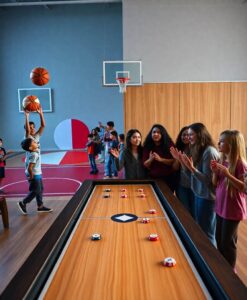
For anyone interested in improving how students learn difficult concepts, this work ties together classroom design, game-based learning, and transfer of knowledge. It raises practical questions about when to group diverse examples together and how to scaffold learners with varying prior knowledge. Follow the link to read the full article and see how these simple games might scale to classrooms focused on growth and inclusion.
Abstract
We codesigned and evaluated a brief intervention combining two fraction games: Fraction Ball (played on a basketball court) and Bottle Caps Bonanza (played on a tabletop shuffleboard). Using participatory design principles, we engaged teachers and students in codesigning playful learning experiences aimed at improving knowledge transfer and adding fractions with unlike denominators. Students were randomly assigned within seven treatment classrooms to practice fractions with different denominators on one board simultaneously (N = 87) versus practicing on separate boards sequentially (N = 79). Three comparison classrooms (N = 75) only took the pretest and posttest. Our preregistered models suggested significant impacts on multiple aspects of fraction knowledge, including far transfer and overall fraction knowledge, when comparing both treatment groups to the comparison group. The simultaneous condition performed higher on untimed fraction addition with unequal denominators, though this difference was not statistically significant (b = 0.21, p = .05). Furthermore, students with higher prior knowledge benefited more from the simultaneous condition. We conclude that this playful and accessible intervention can effectively improve students’ fraction knowledge.